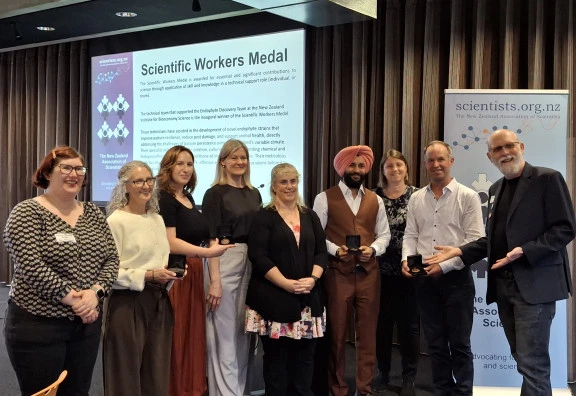
The New Zealand Association of Scientists’ (NZAS) Scientific Workers Medal was yesterday (Wednesday 26 November) presented to a multidisciplinary team of technicians from the Bioeconomy Science Institute.
The team was honoured for its contribution to developing a novel endophyte strain, known as AR37, that makes ryegrass more resistant to insect pests while minimising adverse impacts on livestock.
The breakthrough is estimated to have contributed $3.6 billion to the New Zealand economy over the past two decades and earlier this year won the Prime Minister’s Science Prize.
The technicians recognised include Nicola Webb, Anouck de Bonth, Joanne Jensen, Debbie Hudson, Russell Croy, Won Hong, Leo Liu, Yulia Morozova, Jana Schmidt, Jaspreet Singh, Jan Sprosen, Lee Sutherland, Zane Webber and Michelle Williamson.
Nicola Webb, who accepted the award on behalf of the team, says she was “utterly shocked” by the win and delighted to share the moment with Dr Tony Conner, who nominated them. Dr Conner was at the ceremony to accept his own honour – the Marsden Medal – for his pioneering work in plant genetics and improving crop resilience.
Webb says the award marks a “positive shift” in the science community towards recognising everyone involved in scientific discoveries, not just scientists.
“It acknowledges the significant contributions technicians make behind the scenes,” Webb says.
“This award is for all the technicians who have worked in the Endophyte Discovery Team, past and present.”
Webb says the team’s success reflects the incredible support they had from scientists and commercial partners.
She says their work continues today, with ongoing research into endophytes to strengthen New Zealand’s farming systems.
“This research is imperative to protecting one of New Zealand’s biggest assets – our ryegrass pastures,” she says.
“We’re still finding improvements to better support farmers. These real-world impacts are what inspire us to keep going.”