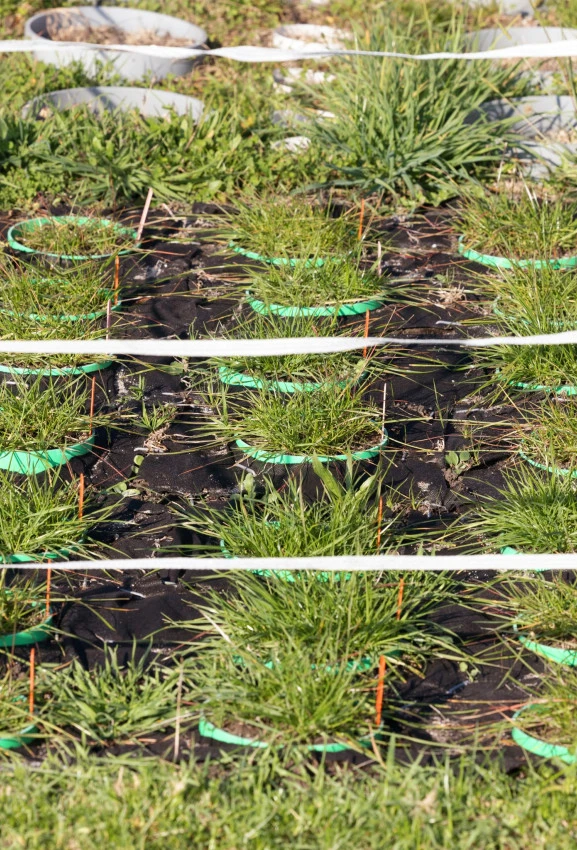
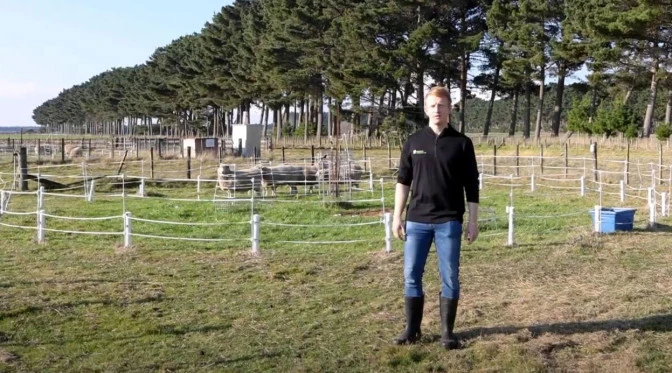
A prescient experiment known as Free Air Carbon Dioxide Enrichment (FACE) provided enduring benefits for scientists studying and managing the effects of climate change on pastoral agriculture. AgResearch set up an experiment in the late 1990s using purpose-built technology to control elevated atmospheric carbon dioxide on pastures. The programme and field facility were based at a research farm in the lower North Island. Atmospheric carbon dioxide levels were artificially elevated to 500 parts per million (levels expected by the year 2050) across plots of pasture measuring 12 metres in diameter. The pasture within the rings was typical of those commonly found on many New Zealand farms.
Climate Change Research
01
Research on the effects of climate change on pastoral agriculture
Climate Change Research
02
22 years worth of data sets
The experiment is unique in that it includes grazing animals and has been running for so long. Now 22 years old, FACE has produced data sets that scientists from all over the world are still finding new and innovative applications for as well as becoming the established and key plank of our “Climate change and the pastoral sector: Impacts and adaptation” programme funded by MBIE’s SSIF.
FACE experiment’s data sets are used to verify models and contribute to meta-analyses, as well as to improve climate change impact studies and adaptation testing. Adapted technologies (such as climate proof plants) can also be directly tested in the FACE to see if they are going to work as expected under climate change. Data and key outputs of the FACE experiment have also been integrated into an international model: the Agricultural Production Systems sIMulator (APSIM).
Scientists can use APSIM to simulate agricultural systems that cover a range of plant, animal, soil, climate and management interactions and visualise potential future scenarios, allowing them to explore potential impacts and plan adaptation strategies. APSIM’s AgPasture module can accurately simulate pasture systems in New Zealand, across a wide range of soil types and climates.
The data sets from the FACE experiments are used to check that the output from APSIM gives a valid projection of the future. This provides confidence that impact and adaptation studies for the pastoral sector give a realistic assessment of a future under climate change.
Preparing pastoral systems for a higher CO2 future
This document provides an overview of the New Zealand Free Air Carbon Dioxide Enrichment (FACE) Experiment, highlighting its impact and key findings.
Download (pdf 1.1 MB)Video
Latest Work
Research
NZBIDA: Dairy Farm of the Future
Active
Te Tauihu Indigenous Materials
Active
New Zealand Bioeconomy in a Digital Age
Active

Case Study
Research strengthened by te ao Māori
AgResearch is embracing mātauranga Māori by building understanding between science and Māori knowledge systems.
10 Min Read