2023: Major changes
The long-term experiment has survived a major roading change in 2023 with the construction of the Te Ahu a Turanga – Manawatū Tararua Highway. The experiment continues with three farmlets instead of the original four.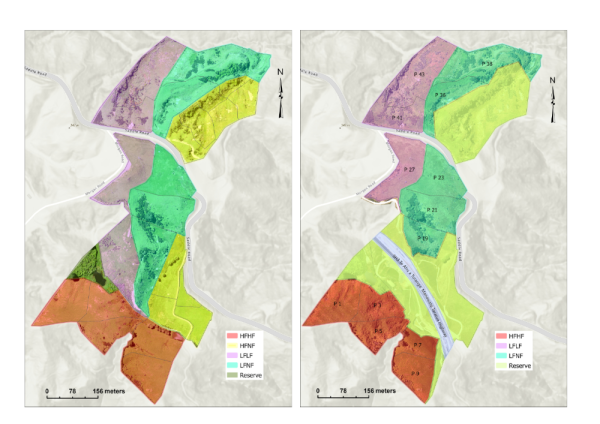
Unfortunately you are viewing this website on an outdated browser which does not support the necessary features for us to provide an adequate experience.
Please switch to a modern browser such as latest version of Google Chrome, Mozilla Firefox, Apple Safari or Microsoft Edge.
A long-term experiment, located on the AgResearch Ballantrae Hill Country Research Station, was established in 1975 to explore the interaction between P fertiliser use and sheep grazing in hill country and how it influences the soil-plant-animal cycle.
The long-term experiment has survived a major roading change in 2023 with the construction of the Te Ahu a Turanga – Manawatū Tararua Highway. The experiment continues with three farmlets instead of the original four.
The intensification of sheep and beef systems is becoming an increasingly common feature of hill country as the competition for class I to IV land from other more profitable pasture enterprises continues to grow. The result has been greater numbers and heavier weight livestock carried on hill land for longer periods of the year.
The continuation of livestock production on hill land will depend on the industry’s ability to demonstrate the sustainability of farming practices. Hill farmers are in a position where they must demonstrate that their farming practices do not degrade on-farm resources (soils, vegetation or animals) or impact negatively off-site on water quality.
The four self-contained farmlets include two farmlets that received low (LF) and two that received high (HF) P fertiliser inputs from 1975-1980. Since 1980, one of the LF farmlets has continued to receive 125 kg superphosphate (SSP)/ha/yr (LFLF) and one of the HF farmlets has received 375 kg SSP/ha/yr (HFHF). The other LF and HF farmlet have received no further inputs (LFNF and HFNF, respectively). Monitoring of the HFNF stopped in 2022 with the development of the new road impacting too many permanent experimental sites.
This long-term experiment is a living lab that provides an invaluable resource to assist New Zealand in forecasting future changes
Pasture production

Figure. Exclusion cages on the medium slope for monitoring pasture growth on the farmlets, along with information in P fertiliser history, net herbage accumulation, pasture species composition and sheep stocking rate.
Stocking rates

The increase in sheep stocking rates from 6 su/ha in 1975 to 10.6 and 16.1 su/ha on the LF and HF farmlets, respectively, by 1980 demonstrates the impact of P fertiliser inputs on productivity. The decline in sheep stocking rates since 2000 is at odds with controlled environment studies and ecosystem modelling that have been suggesting that elevated atmospheric CO2 concentrations and warming temperatures associated with climate change would result in an increase in primary production.
Soil phosphorus fertility

After no P fertiliser inputs for over 40 years, the Olsen P levels on the NF farmlet are 6 ug/ml. Olsen P levels, on the HF farmlet, are 50 ug/ml. The absence of an ongoing increase in soil P levels since 2003 might be explained by the significant amounts of P found at depth in the soil on the HF farmlet. The absence of any changes in Olsen P on the LF farmlet reflects the fact that current P fertiliser inputs are close to the maintenance P requirements for that farmlet.
Soil biology

Earthworm abundance reflects the difference in pasture production between the farmlets, with numbers lower in the NF farmlet (219 m-2), compared with the LFLF (384 m-2) and HF (428 m-2) farmlets. Both accidental and deliberate anthropogenic earthworm introductions have resulted in an increased earthworm diversity since 1975.
Soil organic carbon

A major finding emerging from the long-term experiment is the absence of any differences in the soil organic carbon stocks across the three farmlets, despite a 2 to 3-fold difference in productivity between farmlets.
Nutrient cycling

The Grass-NEXT in capturing the transfer and spatial redistribution of P, C and N for topographically diverse grasslands provides us with a research model to explore nutrient dynamics in complex landscapes and a research tool for exploring management options for increasing SOC and TSN.
Conclusion
The long-term experiment has become an invaluable field laboratory for in-depth experimental studies, for sense checking models, a resource for policy and industry and important extension resource.
Send an email to one of our team or check out our facilities located across Aotearoa New Zealand.